Specialist Tool
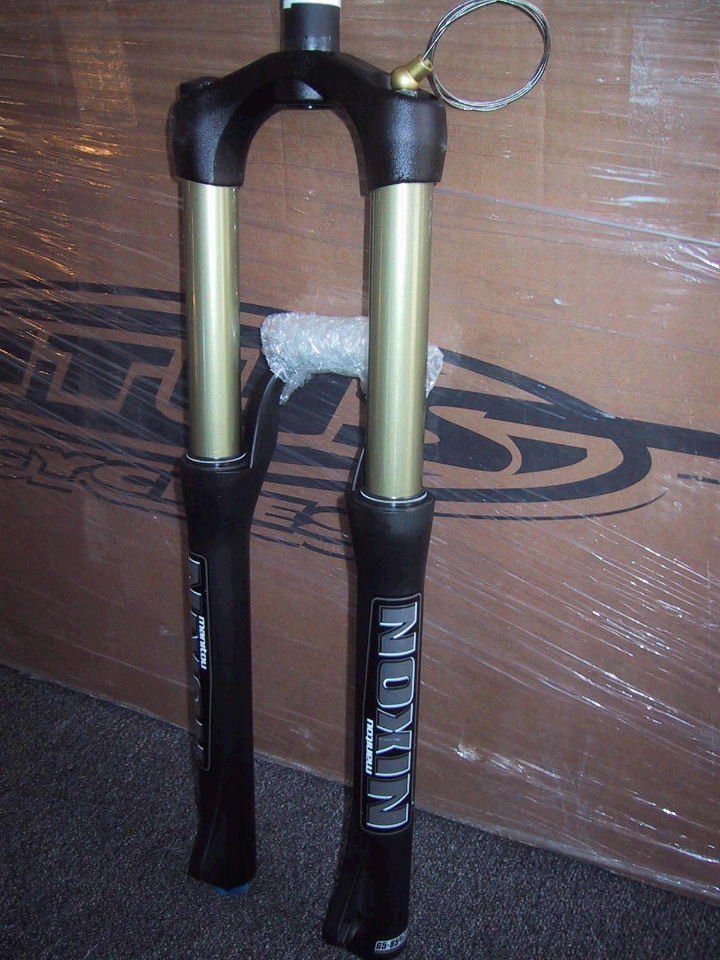
Whilst I was on call last week (couldn't go too far far :( ) I decided to completely strip down my front bouncer to check the state of the compression/rebound/air cartridges. It didn't take long to pop off the lowers, drain the open bath oil before the compression and rebound assembles come out easily enough with standard tools. Depressing the shraeder valve I started to unwind the air cartridge with a 22mm spanner as Chipmunk came in to see how it was going. She'd no sooner got alongside when "BANG"! the cartridge fired itself across the work bench into the side of my toolbox :O Poor Chippy jumped so high I thought she'd paint the eve's whilst up there :p Anyhow, nothing was damaged although my partners heart rate took a while to calm down.
Cleaning and inspecting the exposed guts didn't reveal any nasty surprises, phew, so I started to reassemble when I hit problem#1. The IT (Manitou's air travel adjust system) was still installed in the left stanchion and if you looked up there a small 5mm tube was in the center. The air cartridge is fed into the stanchion and the IT rod should run up it's center. "Should" but didn't :( The teeny rod was off slightly center and no amount of fiddlin' and tweakin' could get the three components to align.
 OK, I'll remove the IT unit...problem#2, which can't be removed with simple tools. Instead it needs a deep slotted socket to clear the gonzo cable feed. The appropriate gadget costs in the region of £40 :( Not willing to shell out such mula for such a low use item I identified a suitable socket, grabbed a grinder and 5mins later we had ourselves a specialist tool, for nowt :D 2mins later and the awkward lickle IT rod was removed.
 With all the guts spilled I checked the condition of the seals, which didn't seem too bad at all. However, the service guide made a point of always replacing the "quad" seals associated with the IT system, so off I went for a t'interweb search. Problem#3 surfaced when my previously bookmarked spares pages didn't work and Google only showed spares in the USA. I even called TFTunedShox but Tim himself (not a fan of the IT system) didn't hold out any hope of acquiring spares due to the distributor and ownership changes with Manitou. Blast.
Oh well, I'd have to pop it all back and see if everything worked. With liberal amounts of MPrep lube, 7.5w suspension oil (compression/rebound), engine oil (open bath lube) and oil soaked foam rings the bouncer was back in one piece. 140psi was added equalising the IT chambers to get a consistent pressure and we were ready for a test ride. A short loop dicing with Chipmunk showed no obvious ill effects from my ham fistedness. Riding very nicely, plush with plenty of adjustment which may well have been down the oil level - 10mm too high and I've also used a heavier 7w instead of 5w. I did find the bouncer to be a little soft and checking the gauge confirmed a few psi loss. Closer inspection of the shrader valve showed it was bent and needed replacing, problem#4. Fixed with motor factors spares the Nixon was loaded with 140psi.
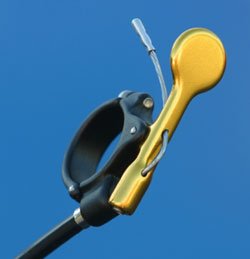
An overnight PSI check revealed a 20psi deficit and depressing the lever extended the fork back to full length - where I'd left the evening before :rolleyes The manual suggests that this negative creep is down to a defunct outer quad seal and spares are proving to be thin on the ground at the moment. A thread state side over on MTBR appears to have highlighted an suitable source of appropriate o-rings but the web page only lists bulk orders.
Chad has even phoned Manitou stateside for me but they're busy relocating between facilities so I either wait until the manufacturer is back online, source parts from elsewhere that may not fit or acquire another fork. Hmmm, I wonder...
Cleaning and inspecting the exposed guts didn't reveal any nasty surprises, phew, so I started to reassemble when I hit problem#1. The IT (Manitou's air travel adjust system) was still installed in the left stanchion and if you looked up there a small 5mm tube was in the center. The air cartridge is fed into the stanchion and the IT rod should run up it's center. "Should" but didn't :( The teeny rod was off slightly center and no amount of fiddlin' and tweakin' could get the three components to align.
 OK, I'll remove the IT unit...problem#2, which can't be removed with simple tools. Instead it needs a deep slotted socket to clear the gonzo cable feed. The appropriate gadget costs in the region of £40 :( Not willing to shell out such mula for such a low use item I identified a suitable socket, grabbed a grinder and 5mins later we had ourselves a specialist tool, for nowt :D 2mins later and the awkward lickle IT rod was removed.
 With all the guts spilled I checked the condition of the seals, which didn't seem too bad at all. However, the service guide made a point of always replacing the "quad" seals associated with the IT system, so off I went for a t'interweb search. Problem#3 surfaced when my previously bookmarked spares pages didn't work and Google only showed spares in the USA. I even called TFTunedShox but Tim himself (not a fan of the IT system) didn't hold out any hope of acquiring spares due to the distributor and ownership changes with Manitou. Blast.
Oh well, I'd have to pop it all back and see if everything worked. With liberal amounts of MPrep lube, 7.5w suspension oil (compression/rebound), engine oil (open bath lube) and oil soaked foam rings the bouncer was back in one piece. 140psi was added equalising the IT chambers to get a consistent pressure and we were ready for a test ride. A short loop dicing with Chipmunk showed no obvious ill effects from my ham fistedness. Riding very nicely, plush with plenty of adjustment which may well have been down the oil level - 10mm too high and I've also used a heavier 7w instead of 5w. I did find the bouncer to be a little soft and checking the gauge confirmed a few psi loss. Closer inspection of the shrader valve showed it was bent and needed replacing, problem#4. Fixed with motor factors spares the Nixon was loaded with 140psi.
An overnight PSI check revealed a 20psi deficit and depressing the lever extended the fork back to full length - where I'd left the evening before :rolleyes The manual suggests that this negative creep is down to a defunct outer quad seal and spares are proving to be thin on the ground at the moment. A thread state side over on MTBR appears to have highlighted an suitable source of appropriate o-rings but the web page only lists bulk orders.
Chad has even phoned Manitou stateside for me but they're busy relocating between facilities so I either wait until the manufacturer is back online, source parts from elsewhere that may not fit or acquire another fork. Hmmm, I wonder...
| 4
Comments
|
 Jump to Top of Page,
Post
Jump to Top of Page,
Post